
ETLAQ SPACEPORT: OMAN'S COMMERCIAL GATEWAY TO ORBIT
Where the Arabian Desert meets an unobstructed 1,500-kilometer Indian Ocean flight corridor, the Sultanate of Oman is pioneering the Middle East's first commercial orbital spaceport.
Combining near-equatorial physics, year-round cloud-free skies, and a revolutionary 45-day regulatory approval framework, Etlaq Spaceport in Duqm is engineered to solve the global aerospace bottleneck and anchor sovereign high-tech capability under Oman Vision 2040.
Section: Global Launch Economics & The Equatorial Advantage: Why international satellite operators gain a payload boost launching at 19°N latitude vs. Europe or East Asia.
Section: Bilateral Aerospace Footprint: Highlight the strategic cooperation, technology-transfer agreements, and commercial interest from France (launch vehicle telemetry/space diplomacy), the United Kingdom (low-Earth orbit commercial constellations), Spain (defense & aerospace tracking systems), and China (regional infrastructure & satellite corridors).
Section: Inward Investment in Duqm’s Downstream Space Cluster: Component testing, ground telemetry, and microgravity research facilities for foreign aerospace ventures under OPAZ.
WHY A DESERT FISHING TOWN IN OMAN IS REDRAWING THE GLOBAL LAUNCH MAP
In Arabic, Etlaq (إطلاق) means "to launch" or "to release." Along the limestone cliffs and sabkha plains of Area 45 in the Special Economic Zone at Duqm (SEZAD), that name has become physical reality. While legacy spaceports in North America and Europe face congested air corridors, 18-to-24-month licensing queues, and high-latitude orbital penalties, Oman has quietly engineered the Middle East's first commercial orbital and suborbital spaceport.
Operated by Etlaq Services L.L.C.—a strategic joint venture between the National Aerospace Services Company (NASCOM, 75%) and Omantel (25%)—Etlaq is not a state vanity project. It is an open-access commercial spaceport designed so international rocket builders from Britain, France, Spain, Germany, Singapore, and Australia can ship a vehicle into the Port of Duqm, clear licensing in 45 days, and launch directly over the open Indian Ocean.
ETLAQ SPACEPORT: OMAN'S COMMERCIAL GATEWAY TO ORBIT
Where the Arabian Desert meets an unobstructed 3,000-kilometer Indian Ocean flight corridor—giving commercial launch operators near-equatorial physics, year-round desert skies, and a 45-day regulatory fast-track.
THE PHYSICS OF 18° NORTH: EARTH'S FREE 1,590 KM/H SLINGSHOT
Why does latitude matter so much to rocket engineers? Because the Earth is a spinning sphere. At the Equator (0°), the surface rotates eastward at 1,670 km/h (465 m/s). As you move closer to the poles, that rotational radius shrinks, and the free velocity boost drops with the cosine of latitude.
At 18°–19.65° North, a rocket sitting on the pad in Duqm is already traveling eastward at roughly 1,590 km/h (442 m/s) before its engines even ignite—retaining 95% of the maximum theoretical equatorial boost.
Compared to high-latitude sites in Scotland (58° N), Sweden (67° N), or New Zealand (39° S), launching from Duqm saves hundreds of kilograms of propellant on every flight. In commercial spaceflight, saved fuel translates directly into heavier customer satellites, longer satellite operational lifespans, and lower cost per kilogram to orbit.
FIVE REASONS ETLAQ STANDS APART IN THE SPACE ECONOMY
- 1. Equatorial Physics & Open-Ocean Azimuths (18.8°N): Rockets launching east capture ~440 m/s of Earth's rotational speed while flying entirely over the Arabian Sea and Indian Ocean, allowing a single coastal range to serve both equatorial and polar/Sun-synchronous trajectories.
- 2. The 45-Day Regulatory Fast-Track: On 16 October 2025, Oman's Civil Aviation Authority (CAA) unveiled a 45-day launch approval framework, cutting through the 12-to-24-month licensing bottlenecks that delay commercial rocket developers in North America and Europe.
- 3. Sovereign Telecom & Equity Backing (NASCOM 75% • Omantel 25%): Operated by Etlaq Services L.L.C. (CR No. 1455190), the spaceport is jointly owned by NASCOM L.L.C. (75%) and Omantel (25%), ensuring mission-critical fiber connectivity, low-latency telemetry downlinks, and subsea cable integration right at the launch range.
- 4. Sea, Air & Industrial Integration in Duqm: Located 170 km south of the deepwater Port of Duqm, the range connects directly to a 2,000 km² Special Economic Zone (SEZAD) and Duqm Airport, allowing oversized rocket stages to arrive by sea and sensitive satellite payloads by air.
- 5. Neutral Diplomatic Crossroads: Positioned outside the Strait of Hormuz, Oman's trusted neutrality enables European, Asian, and Oceanian aerospace companies to collaborate on a single, secure range.

FREE EASTWARD VELOCITY BY GLOBAL LAUNCH SITE
Surface rotational speed imparted by Earth's spin ($v = 465.1 \times \cos(\text{latitude})$ m/s). Higher speed means less fuel burned to reach orbit and more payload mass per launch.
Note: Etlaq delivers nearly double the rotational velocity assist of northern European pads while still offering a clean due-south corridor (180°) for polar Sun-Synchronous Orbits.
FIVE ORBITS, FOUR LAUNCH COMPLEXES
Etlaq is master-planned across four specialized launch complexes on the Hitam coast to serve every commercial orbital regime:
- Equatorial (Low Inclination): Maximum rotational boost for telecom constellations serving the tropics and mid-latitudes.
- Sun-Synchronous (SSO): Passes over the same coordinates at the same local solar time daily for precision Earth observation.
- Polar (Global Coverage): Clean north-to-south trajectories over the Indian Ocean for global mapping and weather monitoring.
- Medium Earth Orbit (MEO): Mid-altitude regimes utilized by navigation, positioning, and maritime timing constellations.
- Geostationary (GTO Transfer): High-energy transfer paths for sovereign broadcasting and telecommunications satellites.
Launch Complex Architecture: LC1 supports suborbital sounding rockets; LC2 serves light commercial launchers; and LC3A & LC3B handle medium-lift orbital vehicles up to 3,500 kg.
COMMERCIAL SPEED TO ORBIT: FAST LICENSING, HIGH PAYLOADS, ZERO BOTTLENECKS
By uniting 18° N equatorial physics, unobstructed 3,000-kilometer Indian Ocean flight corridors, and Oman's 45-day regulatory approval framework, Etlaq eliminates the multi-year launch queues holding back the global commercial satellite economy.
H.H. Sayyid Azzan bin Qais Al Said: Pioneering Oman's Orbital Frontier
Under the visionary guidance of His Highness Sayyid Azzan bin Qais Al Said, Founder and Chairman of the National Aerospace Services Company (NASCOM), Oman is enacting one of the most consequential economic transformations in the Arabian Peninsula. Rather than remaining an importer of satellite services, Oman has established the first sovereign commercial orbital spaceport in the MENA region.
“Etlaq Spaceport represents Oman's sovereign leap into the trillion-dollar global space economy. By capitalizing on Duqm's irreplaceable equatorial physics, open ocean downrange safety, and swift regulatory governance, Oman provides international launch operators with an unconstrained highway to orbit while cultivating homegrown aerospace engineering and high-value In-Country Value.”
— His Highness Sayyid Azzan bin Qais Al Said, Chairman of NASCOMSOVEREIGN ACCORDS ACROSS BRITAIN, FRANCE, SPAIN & GERMANY
Catalyzed by His Majesty Sultan Haitham bin Tarik's landmark state visits to the United Kingdom and France, Oman's Ministry of Transport, Communications and Information Technology (MTCIT) and Etlaq established formal bilateral aerospace partnerships across Europe:
- UK Space Agency (UKSA): Technical exchange protocol ensuring seamless regulatory harmonization and launch authorization between British satellite developers and Duqm range safety.
- Latitude (France — Zephyr Launcher): Multi-year orbital launch agreement securing dedicated flight slots from Hitam's coastal launch pads for European commercial payloads.
- PLD Space (Spain — MIURA 5): Strategic operational collaboration establishing Duqm as PLD Space's secondary global launch site for open Indian Ocean orbits.
- HyImpulse (Germany — SL1 Hybrid Rocket): Flight testing partnership utilizing Duqm's 140 km suborbital corridor for high-altitude microgravity research.

THE SOVEREIGN WINDFALL: BEYOND THE LAUNCH PAD
Etlaq is operated by Etlaq Services L.L.C. (CR 1455190), a strategic national joint venture owned by NASCOM (75%) and national telecom champion Omantel (25%). This equity alliance transforms rocket launches into a multifaceted economic multiplier:
- Subsea Cable Integration: Leveraging Omantel's landing stations for 14+ international subsea fiber cables, Etlaq delivers downlinked orbital telemetry directly to global mission control centers at ultra-low latencies.
- SEZAD Industrial Synergies: Integrated within the 2,000 km² Duqm Special Economic Zone, stimulating local cryogenic propellant supply, clean room assembly, and high-value aerospace engineering jobs.
- Oman Vision 2040 Pillar: Accelerating economic diversification away from hydrocarbon dependence toward high-tech knowledge, defense technology, and commercial space logistics.
THE SOVEREIGN MIDDLE EAST SPACE GATEWAY: NEUTRALITY, TRUST, AND GLOBAL PARTNERSHIP
Rooted in the leadership of His Highness Sayyid Azzan bin Qais Al Said and Oman's time-tested geopolitical neutrality, Etlaq unites British, French, German, and Asian space agencies onto a single peaceful coastal launch complex.
FOUR PLANETARY SCIENCE FRONTIERS MONITORED FROM ORBIT
Etlaq's dual launch azimuths (equatorial and polar) allow domestic and international researchers to deploy dedicated Earth observation constellations addressing critical climatic and economic challenges:
- 1. Subsurface Aquifer Radar: L-band Synthetic Aperture Radar (SAR) penetrates desert sand sheets to map hidden fossil water aquifers in Dhofar and the Rub' al Khali.
- 2. Cyclone Early Warning: Rapid-revisit thermal infrared sensors over the Arabian Sea predict cyclonic storm tracks (mitigating disasters like Cyclone Gonu and Shaheen) hours before landfall.
- 3. Indian Ocean AIS Tracking: Real-time maritime space surveillance safeguarding the 30% of global seaborne petroleum passing through the Strait of Hormuz and Gulf of Oman.
- 4. Direct-to-Device 5G Mesh: Hybrid satellite-cellular connectivity deployed with Omantel, blanketing desert oil fields, offshore fishing fleets, and remote communities.
LINKING ORBITAL TELEMETRY TO SALALAH'S £1B+ AI DATA HUB
Raw satellite data is only as valuable as the compute power available to analyze it. Etlaq's downlinks are coupled through high-capacity optical fiber directly into the £1B+ Yamna AI computing center in Salalah.
Powered by renewable solar and green energy, massive AI models ingest millions of square kilometers of orbital Earth observations in seconds—delivering automated agricultural crop health alerts, mineral exploration maps, and autonomous maritime routing in real time.

THE GENESIS COMPLEX: MULTI-PAD ARCHITECTURE
Covering 533,968 m² under an official usufruct decree in Area 45 of SEZAD, the Etlaq launch masterplan is engineered for scalable orbital throughput:
- Launch Complex 1 (LC1 — Operational): Suborbital sounding rocket pad and educational test envelope (up to 140 km apogee).
- Launch Complex 2 (LC2 — 2026): Dedicated commercial micro-launcher pad (up to 1,000 kg into Sun-Synchronous Orbit).
- Launch Complex 3A & 3B (LC3 — 2027): Dual medium-lift orbital pads (up to 3,500 kg payload capacity into LEO and GTO).
Turnkey Range Services: Integrated payload processing facilities, cryogenic LOX/RP-1 storage, and automated range safety tracking systems.
THE 2027 FRONTIER: WHERE SPACE DOWNLINKS POWER PLANETARY INTELLIGENCE
From deep subterranean aquifer exploration to Salalah's £1B+ green AI computing engines, Etlaq bridges the gap between orbital mechanics and life-sustaining technology on Earth.
🚀 WHAT IS ETLAQ? OMAN’S VERY OWN REAL-LIFE SPACEPORT!
Imagine standing on the warm coastal sands of Oman, hearing the giant countdown roar across the desert—3... 2... 1... IGNITION!—and watching a real rocket blast into the sky, climbing higher than airplanes, higher than the clouds, straight into outer space!
That is Etlaq: the Sultanate of Oman’s official space launch center at Duqm. It is where real engineers build launch pads, fuel rocket engines, and send satellites spinning around our planet.
🛠️ BUILD YOUR OWN SATELLITE: THE TAKWEEN LABS
You don’t have to wait until you are a grown-up to do real rocket science. Through Oman’s Takween Student Space Program, school students and university teams get to build real space hardware:
- Mini CubeSats: Build a tiny satellite the size of a coffee cup (10 cm)! You plug in solar panels, mini cameras, and sensors to measure temperature high above Earth.
- Ride on a Real Rocket: Your school experiment gets strapped inside suborbital rockets like Duqm-1 or AZAD “The Dreamer” and shot right up into the sky.
- Live Radio Beeps: When your satellite is up there, you sit at mission control screens and receive live signals beamed down to your school laptop!

✨ 5 MINUTES OF PURE ZERO-GRAVITY MAGIC!
What happens when a research rocket reaches 140 kilometers high? It arches over the top of the atmosphere into the silence of space. For 5 full minutes, gravity switches off:
⛺ DUQM SPACE DISCOVERY CAMP & 10,000 STARS
Have you ever wanted to sit at the controls of a rocket launch? Etlaq’s public Space Discovery Camp is created for kids, families, and school trips:
- 🎮 Take the Flight Director’s Chair: Grab the mission headset, watch the live radar screens, and call out the official launch countdown over the loudspeakers!
- 🥽 Virtual Reality Spacewalks: Put on the VR helmet and take a dizzying walk outside the International Space Station, or hop across giant craters on the Moon.
- 🔭 10,000 Stars in the Dark Desert: Because Hitam has zero city streetlights, the night sky is pitch black. You can see Saturn’s rings, Jupiter’s moons, and shooting stars with massive telescopes!
COULD YOU BE THE FIRST OMANI TO WALK ON THE MOON OR MARS?
Hundreds of years ago, great Omani sea captains sailed across the globe by reading the stars with astrolabes and kamals. Today, the rockets standing tall on the coast of Duqm are pointing back at those same stars.
The universe is waiting for you. Stay curious, ask giant questions, and build the future!
Explore Earth and Space! 🚀
Welcome to the youth space portal! Learn how rockets launch from Duqm into orbit, play interactive space games, and explore the universe with NASA Science Space Place.
🛰️ Visit Official NASA Space Place (spaceplace.nasa.gov) →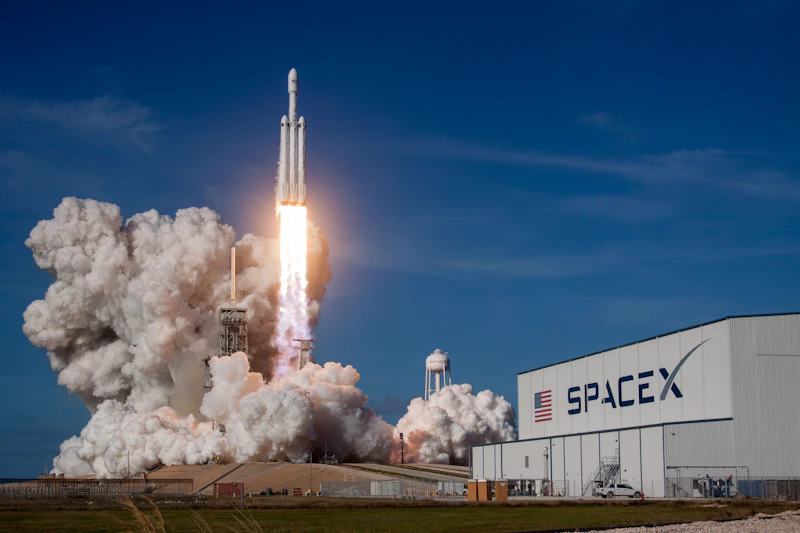


Draw What You Think You Would See on Mars! 🎨
Cadets and young space explorers submitted their vision of Mars volcanoes, rovers, and stars!


Oman’s Next Generation of Space Explorers
Every rocket launch from Etlaq inspires future aerospace engineers, astrophysicists, and satellite technicians across the Sultanate.
A NATION THAT ALWAYS LOOKED UP: WHY DUQM?
For centuries, Omani navigators crossed the Indian Ocean guided by two instruments: the monsoon winds and the stars. Today, the instruments have evolved, but the strategic logic remains identical. Every rocket launch on Earth is governed by three immovable constraints—latitude, downrange safety, and logistics—and very few places on the planet solve all three simultaneously:
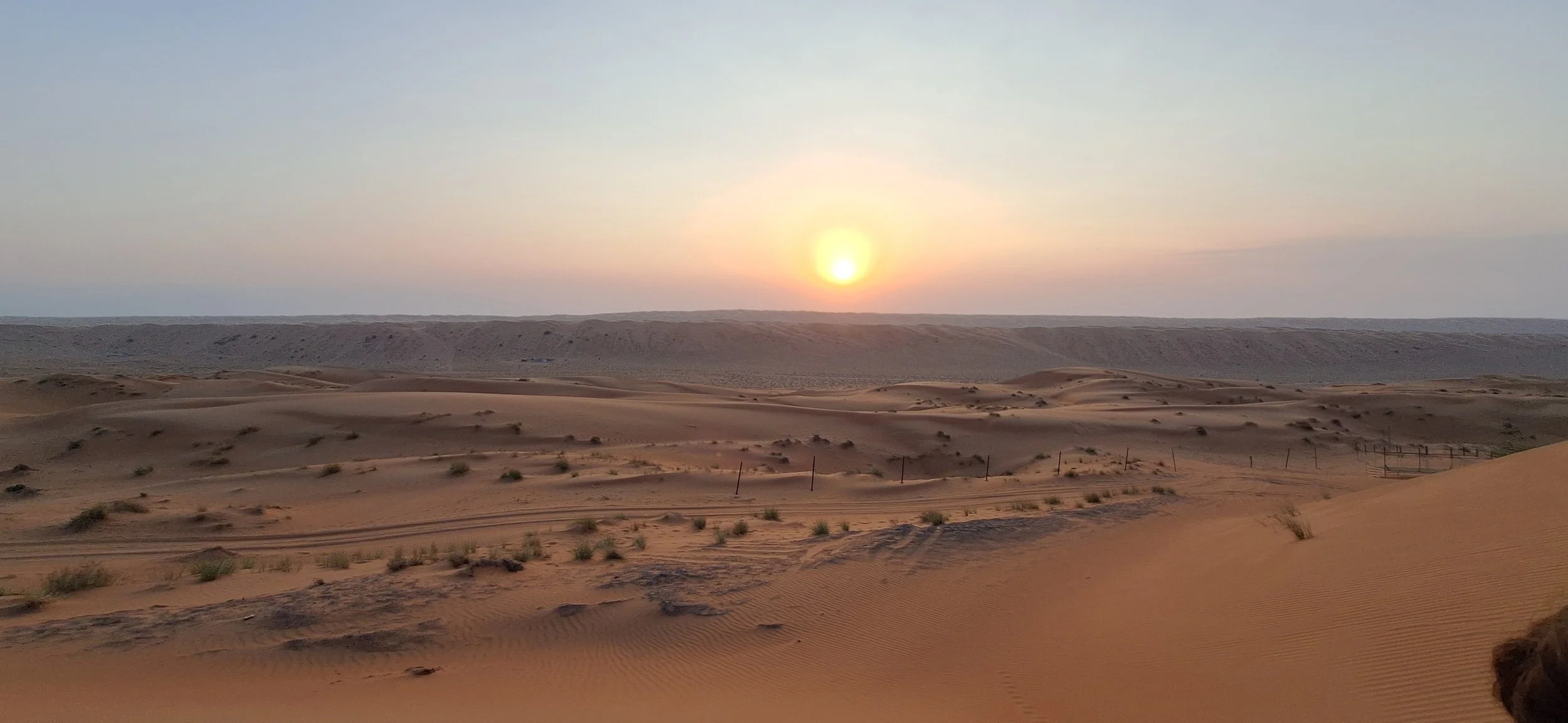
An Empty Ocean From East to South: Launching from Duqm along azimuths between 90° (due East) and 180° (due South) sends rockets directly over the Arabian Sea and Indian Ocean. There are no sovereign territories, cities, or crowded shipping bottlenecks downrange for thousands of kilometers—allowing both equatorial orbits and polar Sun-Synchronous Orbits (SSO) from a single coastal complex.
300+ Cloud-Free Launch Days: Sitting in the arid rain shadow of central Oman, Duqm experiences minimal precipitation, low lightning frequency, and stable upper-level winds outside the brief Khareef fringe, minimizing costly weather scrubs.
Multimodal Heavy Logistics within 80 km: Rocket stages are too large for standard air freight. Within 80 kilometers of Area 45 sit the deep-water Port of Duqm, Duqm International Airport, and wide industrial highways built for mega-refinery modules.
From Founding Vision to Multi-Pad Spaceport
How Oman moved from corporate incorporation to live suborbital launches and European & UK orbital agreements in under five years.
NASCOM Founded
National Aerospace Services Company (NASCOM L.L.C.) is established in Muscat, forming Etlaq Services L.L.C. (75% NASCOM / 25% Omantel) in Nov 2022.
Duqm Land & UK Masterplan
533,968 m² secured in Area 45, SEZAD. First contract awarded to Britain's UK Launch Services Ltd (UK LSL) at the British Embassy in Muscat.
Duqm-1 Launch
Oman's historic first spaceflight reaches 140 km apogee at Mach 4.5 (1,530 m/s), validating range safety and telemetry.
PLD Space & 45-Day CAA Rule
Spain's PLD Space selects Etlaq as its 2nd global MIURA 5 base; Oman CAA establishes its 45-day launch licensing fast-track.
Germany & France Accords
Germany's HyImpulse signs LOI (2 Jun); France's Latitude signs launch accord during HM Sultan Haitham's Paris State Visit (1 Jul).
Karman X1 Flight
AZAD ("The Dreamer") launches with Stellar Kinetics (Oman), OculloSpace (Singapore), and Orbit2Orbit (Australia).
UK State Visit & AI-Space
UK Space Agency & MTCIT sign Space Cooperation LOI alongside the £1B+ Yamna Salalah AI Data Center during HM's UK State Visit.
Genesis 3-Pad Buildout
Construction of orbital Launch Complex 1 (Medium/Heavy), Launch Complex 2 (Small/Micro), and Suborbital Complex 3.
THE PHYSICS OF 18° NORTH: EARTH'S FREE 1,590 KM/H SLINGSHOT
Why does latitude matter so much to rocket engineers? Because the Earth is a spinning sphere. At the Equator (0°), the surface of the Earth rotates eastward at 1,670 km/h (465 m/s). As you move closer to the poles, that rotational radius shrinks, and the free velocity boost drops with the cosine of latitude.
At 18°–19.65° North, a rocket sitting on the pad in Duqm is already traveling eastward at roughly 1,590 km/h (442 m/s) before its engines even ignite—retaining 95% of the maximum theoretical equatorial boost. Compared to high-latitude sites in Scotland (58° N), Sweden (67° N), or New Zealand (39° S), launching from Duqm saves hundreds of kilograms of propellant on every flight. In commercial spaceflight, saved fuel translates directly into heavier customer satellites, longer satellite operational lifespans, and lower cost per kilogram to orbit.
Free Eastward Velocity by Global Launch Site
Surface rotational speed imparted by Earth's spin (v = 465.1 × cos(latitude) m/s). Higher speed means less fuel burned to reach orbit and more payload mass per launch.
Note: Etlaq delivers nearly double the rotational velocity assist of northern European pads while still offering a clean due-south corridor (180°) for polar Sun-Synchronous Orbits.
The 45-Day CAA Launch Approval Fast-Track
In global aerospace, waiting for a launch license often takes longer than building the rocket. In October 2025, Oman's Civil Aviation Authority (CAA) introduced a dedicated spaceflight regulatory framework with a 45-day launch approval window.
NASCOM (75%) & Omantel (25%) Equity Alliance
Etlaq Services L.L.C. (CR No. 1455190) combines agile aerospace engineering with sovereign digital infrastructure through a strategic equity partnership forged in January 2024:
FROM FOUNDING VISION TO MULTI-PAD SPACEPORT
How Oman moved from corporate incorporation to live suborbital launches and European & UK orbital agreements in under five years.
National Aerospace Services Company (NASCOM L.L.C.) is established in Muscat, forming Etlaq Services L.L.C. (75% NASCOM / 25% Omantel) in Nov 2022.
533,968 m² secured in Area 45, SEZAD. First contract awarded to Britain's UK Launch Services Ltd (UK LSL) at the British Embassy in Muscat.
Oman's historic first spaceflight reaches 140 km apogee at Mach 4.5 (1,530 m/s), validating range safety and telemetry.
Spain's PLD Space selects Etlaq as its 2nd global MIURA 5 base; Oman CAA establishes its 45-day launch licensing fast-track.
Germany's HyImpulse signs LOI (2 Jun); France's Latitude signs launch accord during HM Sultan Haitham's Paris State Visit (1 Jul).
AZAD ("The Dreamer") launches with Stellar Kinetics (Oman), OculloSpace (Singapore), and Orbit2Orbit (Australia).
UK Space Agency & MTCIT sign Space Cooperation LOI alongside the £1B+ Yamna Salalah AI Data Center during HM's UK State Visit.
Construction of orbital Launch Complex 1 (Medium/Heavy), Launch Complex 2 (Small/Micro), and Suborbital Complex 3.
FOUR SCIENTIFIC FRONTIERS POWERED BY ETLAQ
How suborbital sounding rockets and orbital satellites launched from Duqm serve environmental science, maritime security, and next-generation computing:
Sun-synchronous satellites launched southward from Duqm pass over the Middle East daily, tracking aquifers, coral health, and pinpointing methane leaks in real time.
Over 30% of global seaborne crude passes Oman's coastline. LEO satellites provide continuous vessel tracking, illegal fishing detection, and oil-spill alerts.
Sounding rockets sample the mesosphere while offering 3 to 10 minutes of pure microgravity for crystal growth, semiconductor alloys, and university payloads.
Paired with Omantel's subsea cables and the £1B+ Yamna Salalah AI center, raw satellite data downlinks straight into sovereign AI compute clusters.
INTERNATIONAL LAUNCH MANIFEST
Active international agreements and completed missions bridging Europe and the Indo-Pacific:
5 Dec 2024 • 6.5m suborbital rocket reaches 140 km apogee at Mach 4.5. Validated range safety and sea clearance.
2 Oct 2026 • Stellar Kinetics (Oman) + OculloSpace (Singapore) + Orbit2Orbit (Australia). 4.3m rocket payload.
Signed 21 Feb 2025 • Selected Etlaq as 2nd global launch base for two-stage orbital MIURA 5 (flights late 2026+).
Signed 1 July 2026 during Paris State Visit • Dedicated microlauncher for European smallsat constellations.
Signed 2 June 2026 • Hybrid-propulsion suborbital SR75 and orbital SL1 multi-stage vehicles.
COMMERCIAL GATEWAY TO ORBIT
Where the Arabian Desert meets an unobstructed 1,500-kilometer Indian Ocean flight corridor, Etlaq Spaceport in Duqm unites near-equatorial physics, 300+ cloud-free launch days, and a 45-day CAA regulatory fast-track to provide global satellite operators with rapid, unconstrained access to Low Earth and Sun-Synchronous Orbits.

Multiple benefits of Launches for Science and Everyday Life
A rocket is ultimately a precision delivery vehicle; the real transformation happens when its payload reaches altitude.
Climate, Cyclone & Coastal Intelligence: Earth-observation satellites launched into Sun-synchronous orbit monitor sea-surface temperatures, coral reefs, agricultural moisture, and tropical cyclones across the Arabian Sea. For a nation that has navigated extreme weather events such as Cyclones Gonu (2007) and Shaheen (2021), sovereign satellite data directly protects lives and coastal infrastructure.
Upper-Atmosphere & Microgravity Science: Suborbital sounding rockets sample the mesosphere and thermosphere—an altitude band too high for weather balloons and too low for orbital satellites—while providing precious minutes of weightlessness for pharmaceutical, fluid-physics, and materials research.
Resilient Connectivity: Small-satellite constellations in Low and Medium Earth Orbit link remote maritime vessels, energy platforms, and mountain communities directly into Omantel's terrestrial and submarine cable network.
Inspiring a Generation of Omani Engineers: Every countdown in Duqm trains Omani propulsion specialists, avionics technicians, and range safety officers—turning space science from a textbook subject into a hands-on career in the Sultanate.
Four Scientific Frontiers Powered by Etlaq
How suborbital sounding rockets and orbital satellites launched from Duqm serve environmental science, maritime security, and next-generation computing.
Hyperspectral Earth Observation
Sun-synchronous satellites launched southward from Duqm pass over the Middle East and East Africa at the same solar angle every day—measuring underground moisture, tracking tropical cyclones in the Arabian Sea, monitoring date-palm health, and pinpointing fugitive methane emissions from energy facilities in real time.
AIS Ship Tracking & Coral Reef Health
Over 30% of global seaborne crude and container traffic passes Oman's coastline. Low-Earth-orbit satellites launched from Duqm provide continuous Automatic Identification System (AIS) vessel tracking, illegal-fishing detection, oil-spill monitoring, and harmful algal bloom forecasting across the Indian Ocean.
Suborbital Science at 100–300 km
Sounding rockets like Duqm-1 and Karman X1 explore the mesosphere and thermosphere (50–200 km)—an altitude too high for weather balloons and too low for satellites. They also provide 3 to 10 minutes of pure microgravity for protein crystal growth, semiconductor alloy testing, and university payloads.
Direct-to-Device 5G & Space-AI Compute
Paired with Omantel's subsea fiber landings and the £1B+ ($1.3B) Yamna AI Data Center in Salalah announced during HM Sultan Haitham's October 2026 UK State Visit, Oman can downlink raw satellite data directly into sovereign AI compute clusters—processing Earth-observation imagery in milliseconds.
Five Orbits, Four Launch Complexes
Etlaq is master-planned across four specialized launch complexes on the Hitam coast to serve every commercial orbital regime.
Equatorial
Maximum rotational boost for telecom constellations serving the tropics and mid-latitudes.
Sun-Synchronous
Passes over the same coordinates at the same local solar time daily for Earth observation.
Polar
North-south trajectories over the Indian Ocean for global mapping and weather monitoring.
Medium Earth
Mid-altitude orbits utilized by navigation, positioning, and timing constellations.
Geostationary
High-energy transfer paths for sovereign broadcasting and telecommunications satellites.
Hitam Coastal Launch Complexes (LC1 – LC3B)
LC1 supports heavy-lift vehicles, LC2 serves medium-class launchers (such as MIURA 5), and LC3A & LC3B handle micro-launchers and suborbital missions.
Illustrative range schematic showing coastal launch azimuths from Hitam (18.78°N, 56.82°E).

SPACE DIPLOMACY: WHERE BRITAIN, EUROPE, AND THE INDO-PACIFIC MEET ON THE ARABIAN SEA
Etlaq has rapidly become one of the Sultanate's most effective instruments of science and technology diplomacy, connecting British and European aerospace engineering with Indo-Pacific propulsion and payload innovators:
The British Architectural & AI-Space Axis (Nov 2023 & Oct 2026 State Visit): In November 2023, at the British Embassy in Muscat, NASCOM awarded Etlaq's inaugural Spaceport Masterplan contract to Britain's UK Launch Services Ltd (UK LSL), aligning Etlaq's range safety with UK Civil Aviation Authority (UK CAA) standards. During HM Sultan Haitham bin Tarik's historic State Visit to the United Kingdom (20–22 October 2026), Oman's MTCIT and the UK Space Agency signed a bilateral Space Cooperation Framework alongside a £1+ billion ($1.3B) hyperscale AI data center agreement in Salalah (Yamna) and AI-driven Earth-observation satellite initiatives (Open Cosmos & ETCO Space). (See our UK–Oman Diplomatic Dossier).
The Franco-Omani Presidential Milestone (1 July 2026): During HM Sultan Haitham bin Tarik's official state visit to President Emmanuel Macron in Paris, Etlaq signed a strategic launch agreement with French orbital launcher Latitude (Reims) to bring the Zephyr microlauncher to Duqm. (See our France–Oman Diplomatic Dossier).
The European Commercial Launch Hub (Spain & Germany): On 21 February 2025, Spain's PLD Space selected Etlaq as the second global launch base for its orbital MIURA 5 launcher (its first outside French Guiana). On 2 June 2026, Germany's HyImpulse Technologies signed a Letter of Intent to launch its hybrid-propulsion vehicles from Duqm. (See our Spain–Oman and Germany–Oman pages).
The Indo-Pacific Flight Demonstration (2 October 2026 — Karman X1): Under Etlaq's Takween (Formation) program, Omani operator Stellar Kinetics MCT teamed up with Singapore's OculloSpace and Australia's Orbit2Orbit to launch the 4.3-meter AZAD ("The Dreamer") rocket from Duqm. (See our Singapore–Oman page).
Completed Launches & International Launch Manifest
Completed suborbital test flights and signed international launch agreements across the UK, Europe, and the Indo-Pacific.
Duqm-1
- Vehicle
- 6.5 m suborbital experimental rocket (123 kg)
- Thrust
- 33,500 N • Mach 4.5 (1,530 m/s)
- Significance
- Oman's first spaceflight; validated range safety, telemetry, and sea-corridor clearance
Karman X1 — "AZAD"
- Vehicle
- AZAD ("The Dreamer") • 4.3 m, 26 kg
- Partners
- Stellar Kinetics MCT (Oman) & OculloSpace (Singapore)
- Payload
- 1 kg commercial payload for Orbit2Orbit (Australia)
UK Space Agency & UK LSL
- Masterplan
- UK Launch Services Ltd (UK LSL) designed Etlaq's Spaceport Masterplan under UK CAA safety standards
- 2026 Accord
- UK Space Agency & MTCIT Space Cooperation LOI signed during HM Sultan Haitham's UK State Visit
- Space + AI
- Paired with the £1B+ Yamna Salalah AI Data Center & Open Cosmos / ETCO Space AI satellites
Latitude — Zephyr
- Partner
- Latitude (Reims, France)
- Diplomacy
- Signed during HM Sultan Haitham bin Tarik's visit to President Emmanuel Macron
- Vehicle
- Zephyr orbital micro-launcher for dedicated smallsat constellations
PLD Space — MIURA 5
- Partner
- PLD Space (Elche, Spain)
- Vehicle
- MIURA 5 orbital two-stage launcher
- Significance
- Selected Etlaq as its 2nd global launch base (and first outside Kourou)
HyImpulse Technologies
- Partner
- HyImpulse Technologies (Neuenstadt, Germany)
- Vehicle
- SR75 suborbital & SL1 three-stage orbital launcher
- Regulatory
- Backed by Oman CAA's 45-Day Commercial Launch Licensing Fast-Track
LEADERSHIP & CORPORATE ARCHITECTURE: H.H. SAYYID AZZAN BIN QAIS AL SAID
Unlike state-run space agencies that rely solely on public appropriations, Etlaq Spaceport is structured as an agile commercial venture anchored by sovereign infrastructure. The spaceport is operated by Etlaq Services L.L.C. (Commercial Registration No. 1455190, incorporated 17 November 2022), a joint venture owned 75% by the National Aerospace Services Company — NASCOM L.L.C. (CR No. 1382778) and 25% by Oman Telecommunications Company (Omantel), the Sultanate's flagship connectivity provider.
NASCOM and Etlaq were founded and are led by His Highness Sayyid Azzan bin Qais Al Said.
Establishing NASCOM in February 2021, H.H. Sayyid Azzan bin Qais Al Said positioned Oman not to build expensive domestic rockets from scratch, but to solve the global space industry's most acute bottleneck: launch pad scarcity, regulatory delays, and equatorial orbital access.
By pairing NASCOM's aerospace and range-safety operations with Omantel's subsea cable landings, sovereign cloud, and low-latency telemetry backbone in Duqm, Etlaq offers international launch providers a turnkey commercial pad with 45-day regulatory turnarounds through the Oman Civil Aviation Authority (CAA).

What Comes Next: 2027 and Beyond
The next chapter is orbit. French launcher Latitude plans an experimental first flight from Etlaq in late 2027. Spain's PLD Space is preparing a MIURA launch base, with MIURA 5 targeted around 2027. These are announced plans, and launch schedules move, but the direction is clear.
Beyond the rockets, a spaceport pulls an ecosystem in behind it: ground stations, satellite assembly, data analytics, training and suppliers. Duqm already hosts a deepwater port, a drydock and a growing green-industry cluster, so it is a natural place for that ecosystem to take root.
Demand for launches is growing faster than the supply of places to launch from. Etlaq gives small-satellite operators in Europe, Asia and Africa a new option, and gives Oman something national: its own door to space.