SINBAD IN BUDAPEST
THE OMANI SAILOR OPERA AT MÜPA — WHERE THE ARABIAN SEA MET THE DANUBE
AN OPERATIC VOYAGE FROM MUSCAT TO BUDAPEST — THE FIRST MAJOR ARABIC GRAND OPERA ON A EUROPEAN STAGE
On the evening of April 12, 2026, a fragrance unlike anything Budapest had ever known drifted through the Béla Bartók National Concert Hall. It carried notes of Omani frankincense, aged sandalwood, and the salt memory of distant shores. As the bespoke scent — crafted by the legendary house of Amouage — settled across the 1,699-seat auditorium, the Hungarian Radio Symphony Orchestra lifted its first notes into the silence. What followed was not merely a performance but a civilisational encounter: the European premiere of Sindbad: The Omani Sailor, a landmark Arabic grand opera that carried the entire soul of Oman's maritime heritage from the shores of the Arabian Sea to the banks of the Danube.
The opera, the crowning event of the Bartók Spring International Art Week 2026, marked a historic milestone in Oman-Hungary cultural diplomacy — a collaboration so ambitious that it required years of artistic negotiations, cross-continental casting, and the convergence of two musical traditions separated by thousands of kilometres yet bound by a shared reverence for the epic voyage.
THE GENESIS: A DREAM BORN IN MUSCAT
The journey of Sindbad: The Omani Sailor began at the Royal Opera House Muscat (ROHM), the jewel of Oman's performing arts landscape. Commissioned as a statement of national artistic ambition, the opera was conceived as the first major Arabic-language grand opera produced to international standards — a work that would place the Sultanate's cultural identity on the global operatic stage alongside the great European traditions.
The world premiere took place on October 3 and 5, 2025, opening the ROHM's 2025/2026 season. The response was extraordinary. Critics described it as a multisensory immersion — a fusion of Western orchestral grandeur with the ancient melodic textures of the oud, the qanoon, and the rhythms of Omani traditional music. Audiences did not merely hear the opera; they breathed it, as Amouage's Sindbad fragrance — a complex olfactory composition of honey, apricot, cardamom, black tea, and aged sandalwood — was gently diffused throughout the auditorium at key dramatic moments, blurring the boundary between art and atmosphere.
"When the fragrance reached the stalls during the storm sequence, I forgot I was in a concert hall. I was on the ship." — Audience member, Royal Opera House Muscat, October 2025
THE CREATIVE ARCHITECTS
The opera's creative team reads like a summit meeting between the Arab world and Central Europe:
Hisham Gabr — Composer & Conductor. The Egyptian-born maestro composed the full orchestral score, weaving Western symphonic architecture with Arabic maqam scales, creating a musical language that belongs to both worlds simultaneously. Gabr himself conducted every performance, shaping a sound that was at once Puccinian in its emotional sweep and distinctly Arabian in its harmonic vocabulary.
Nader Salah El Din — Librettist. The original Arabic libretto reimagines Sindbad not as the fairy-tale sailor of the One Thousand and One Nights, but as a quintessentially Omani hero — a navigator of the Indian Ocean trade routes, a man of Sur whose dhow carried frankincense to the world. The story follows Sindbad's quest to find the legendary "Magic Perfume" to rescue Princess Hayat, interweaving themes of love, ambition, and the sea's eternal call.
Csaba Káel — Director. The Intendant of Müpa Budapest brought European theatrical precision to the staging, designing a visual world that evoked the architectural geometry of Omani forts, the luminous turquoise of the Gulf of Oman, and the golden vastness of the Sharqiyah Sands. His direction bridged two aesthetic traditions without subordinating either.
László Velekei — Choreographer. The principal movements, performed by the Ballet Company of Győr, integrated classical ballet vocabulary with stylised interpretations of Omani folk dance, including elements of the Razha (warrior dance) and the Al-Bar'ah (a UNESCO-listed Omani tradition).
Éva Szendrényi — Stage Designer. Rita Velich — Costume Designer. Vilmos Schön — Lighting Designer. Sándor Alex Rabb — Production Designer.
AN ALL-ARABIC CAST, A HUNGARIAN ORCHESTRA
The casting of Sindbad was itself a statement of cultural ambition. The principal roles were performed entirely by singers from across the Arab world — a deliberate artistic choice that ensured the Arabic libretto lived and breathed with authentic vocal colour:
Ragaa Eldin as Sindbad — the wandering hero, torn between the horizon and the harbour
Dima Bawab as Fairouz — a Jordanian-Palestinian soprano whose crystalline voice embodied both longing and strength
Ashraf Sewailam as Samaan — a bass-baritone of commanding presence, bringing gravitas to the role of Sindbad's rival
Gala el Hadidi as The Sorceress — a mezzo-soprano whose dark, luxuriant timbre conjured ancient enchantment
Reda el Wakil as The Ruler
Hani el Shafei as The Pirate
Dina Iskander as Apprentice of the Sorceress
Two Hungarian performers — Péter Cser (bass, as The Stranger) and Szabolcs Hámori (baritone, as The Messenger) — anchored the European dimension of the cast, their voices threading through the Arabic vocal tapestry as ambassadors of a different tonal tradition.
The Hungarian Radio Symphony Orchestra and the Hungarian Radio Choir provided the sonic foundation — a full symphonic body augmented by an Oriental Ensemble of traditional instruments, creating the opera's signature East-West musical fusion.
BUDAPEST, APRIL 12, 2026: BARTÓK SPRING
The European premiere of Sindbad was not placed in Budapest by chance. It was chosen as the closing gala event of the Bartók Spring International Art Week 2026 — Hungary's most prestigious festival of contemporary and classical performing arts. The selection was a signal: this was not a cultural curiosity but a work worthy of standing alongside the European repertoire.
The Béla Bartók National Concert Hall, with its legendary acoustics and its modernist grandeur, became the stage upon which two civilisations converged. The Omani delegation, the Hungarian cultural establishment, and a diplomatic corps that included officials from both nations witnessed an evening that transcended performance. The auditorium — designed for the symphonies of Bartók, Liszt, and Kodály — resonated with the Arabic maqam for the first time in its history.
The diplomatic significance was unmistakable. The performance came just months after the consolidation of Royal Decree 34/2023, by which His Majesty Sultan Haitham bin Tarik established the resident Embassy of the Sultanate of Oman in Budapest — creating full reciprocal diplomatic representation for the first time. The opera, in this context, was not merely art: it was the cultural ratification of a new bilateral era.
THE HUNGARIAN ECHO: GYULA KRÚDY'S SZINDBÁD
For a Hungarian audience, the name "Sindbad" carries a uniquely local resonance that no other European capital could claim. The great Hungarian novelist Gyula Krúdy (1878–1933) created his own Szindbád — a melancholic, wandering figure who drifts through the cafés, provincial towns, and fading drawing rooms of the Austro-Hungarian Empire. Krúdy's Szindbád cycle, written in the legendary Budapest café culture of the early twentieth century, is one of the most celebrated works of Hungarian literature — an "erotic elegy" to a vanishing world.
There is a statue of Krúdy near Ferenciek Square in Budapest where passers-by can sit beside the writer on a Thonet café chair. In Óbuda, where Krúdy spent his final years, another statue — this one of the character Szindbád himself — gazes out across the Danube.
The Omani Sindbad and the Hungarian Szindbád are, of course, different creations. One sails the Indian Ocean; the other drifts through memory. One seeks a Magic Perfume; the other seeks the taste of a meal long forgotten. Yet both are navigators of the infinite — travellers for whom the journey itself is the destination. The Müpa performance wove these two traditions into a single evening, a dual resonance that no other city on earth could have produced.
"In Budapest, Sindbad has always been at home. He simply arrived this time by a different route — not from the pages of Krúdy, but from the shores of Sur."
AMOUAGE: THE FIFTH SENSE OF OPERA
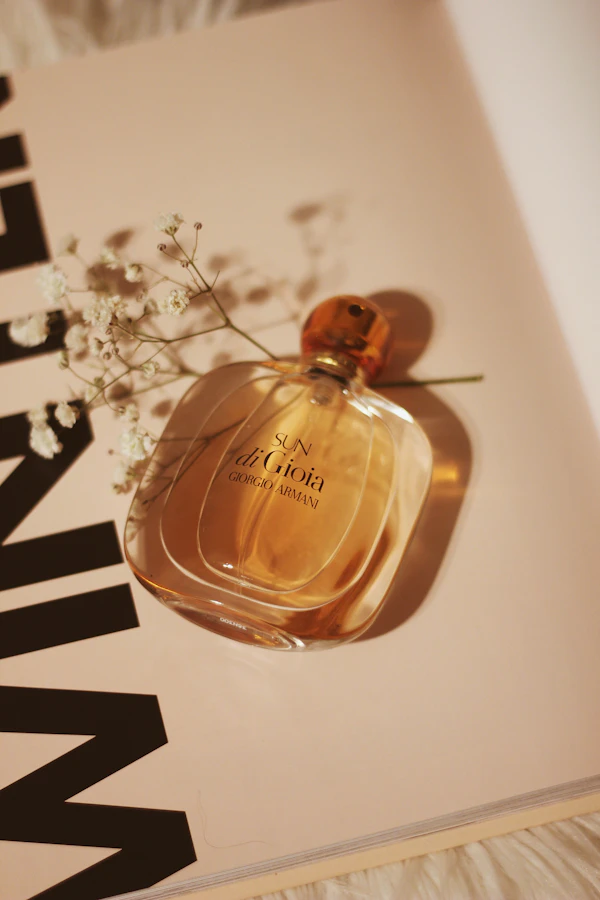
One of the most revolutionary dimensions of the Sindbad production was the collaboration with Amouage, the Omani luxury perfume house. The fragrance Sindbad, created by perfumer Pierre Negrin, was designed as an integral part of the dramatic experience — not a marketing addition but a narrative layer.
The composition opens with warm notes of honey, apricot, mango, and tangerine, accented by cardamom, ginger, and pink pepper. The heart introduces black tea, davana, and a cappuccino accord — a milky, roasted warmth. The base rests on vanilla, tonka bean, cedarwood, labdanum, cypriol, and vetiver. The perfume concentrate was infused for six months with decades-old sandalwood chips, and the bio-ethanol used for dilution was aged in oak barrels.
This fragrance was gently diffused through the auditorium at key dramatic moments — during the storm at sea, during the discovery of the Magic Perfume, during the final embrace. The result was an unprecedented multisensory opera experience: audiences could see, hear, and smell the narrative.
The fragrance was subsequently released internationally under the name Elsewhere due to naming rights restrictions outside Oman — but in Muscat, and in Budapest, it will always be Sindbad.
THE CITY OF SOHAR: WHERE SINDBAD SET SAIL
To understand why this opera exists, one must understand Sohar — the ancient port city on Oman's Al Batinah coast that claims Sindbad as its own. Known in the medieval world as the "Gateway to China," Sohar was one of the most prosperous trading hubs in the Islamic golden age. From its harbours, Omani navigators sailed to India, East Africa, Southeast Asia, and the ports of the South China Sea — journeys that echo through the voyages of the legendary Sindbad.
The connection between Sohar and Sindbad was immortalised in 1980, when the Irish explorer Tim Severin built a replica of a 9th-century Arab dhow and named it Sohar — a direct tribute to the city's status as the legendary mariner's home. Severin sailed the vessel from Oman to China, proving that the epic voyages described in the tales of Sindbad were rooted in the historical reality of ancient Arab seafaring. The dhow Sohar now stands on permanent display at a roundabout in the city, a monument to the voyage that connected legend to fact.
Sohar Fort, a whitewashed fortress overlooking the sea, stands as a sentinel to the city's millennia-long relationship with maritime trade. It is from this heritage — the dhow builders, the navigators, the frankincense merchants who mapped the Indian Ocean centuries before European explorers — that the opera draws its deepest authenticity. Sindbad is not a fantasy figure in Oman; he is a cultural ancestor, a metaphor for the nation's global reach centuries before the age of oil.
The opera's set design, costumes, and choreography drew extensively from Sohar's visual vocabulary: the curved prows of dhows, the woven patterns of Omani textiles, the geometric precision of watchtowers overlooking the sea. When the curtain rose in Budapest, it was Sohar that appeared on the stage.
A NEW CHAPTER IN OMAN-HUNGARY RELATIONS
The Sindbad opera is one element in a rapidly deepening Oman-Hungary bilateral relationship that now spans energy, academia, healthcare, and culture:
Royal Decree 34/2023 — Full reciprocal diplomatic representation with the establishment of the Omani Embassy in Budapest
Green Hydrogen MoU — Technical cooperation in green hydrogen production and methane emissions reduction
MOL Group Block 66 — Hungary's multinational energy company exploring upstream assets in Oman
Stipendium Hungaricum — Fully funded scholarships for Omani students at Hungary's leading universities
MedTech & Semmelweis University — Emerging research bridges between Hungarian and Omani medical institutions
The opera, in this context, is more than entertainment. It is cultural infrastructure — a shared artistic reference point that gives diplomatic and economic ties a human dimension. As the production returns to the Royal Opera House Muscat for encore performances from December 17 to 19, 2026, the cultural corridor between Muscat and Budapest grows ever wider.