ITALY & OMAN: ARCHAEOLOGY AND TOURISM PROMOTION SYMPOSIUM IN MUSCAT
Under the visionary patronage of H.E. Jamal Hassan Al-Moosawi, Secretary-General of the National Museum, and in close coordination with the Embassy of the Italian Republic led by H.E. Ambassador Pierluigi D'Elia, archaeology in Oman has decisively transitioned from a purely academic field into a powerful engine for Sovereign Identity and Elite Cultural Tourism.
The landmark conference, titled "Italy and Oman: Promoting Tourism and Cultural Identity through Archaeology," brought together international scholars, diplomatic figures, and tourism strategists to demonstrate how the Sultanate’s ancient heritage functions as a primary pillar of economic diversification under Oman Vision 2040.
The Patron’s Vision: Museum Diplomacy as National Capital
Through his signature strategy of "Museum Diplomacy," H.E. Jamal Hassan Al-Moosawi has positioned the National Museum as much more than a repository of quiet relics; it is the Institutional Gatekeeper of the nation's true narrative. For the 2026 archaeological season, the National Museum serves as the final destination for groundbreaking discoveries mapped out by Italian researchers, who have been supporting and guiding local historical tracking since the 1970s.
111 (Eleven) Missions of Precision: Securing the Future
As Ambassador Pierluigi D’Elia noted in his opening address, Italy stands as Oman’s premier scientific partner in historical fact-finding. In 2026, 11 active Italian academic teams are deployed across the Sultanate, representing world-class institutions like Sapienza University of Rome, the University of Bologna, and the University of Pisa:
The Nakhal Documentation (Sapienza University): Documenting over 77 complex archaeological structures in the shadow of Nakhal Fort, proving ancient settled life long before modernity.
The Halban Necropolis (University of Bologna): Analyzing 30 monumental Bronze Age burial structures to map out ancient lineage patterns.
The Maritime Legacies (University of Pisa & Naples "L’Orientale"): Unlocking the frankincense shipping structures of Dhofar and Al-Baleed, confirming that Oman's "Sea-faring Soul" is an ancient, completely unbroken lineage.
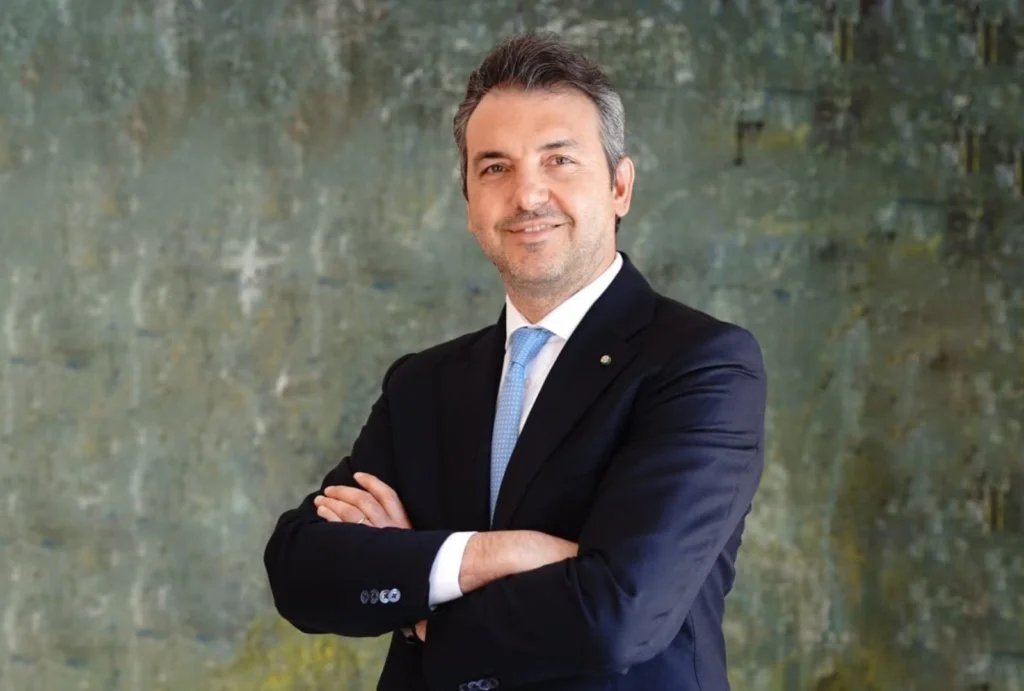
H.E. Ambassador Pierluigi D’Elia
Dr. Fatma Al Balushi, Advisor to the Secretary-General for Museum Affairs, highlighted during her address that the museum's joint lectures and exhibitions purposefully translate scientific data into accessible cultural wealth. Under this shared vision, incoming missions are tasked with more than simple excavation—they are unearthing the Civilizational DNA of the Sultanate, providing the high-fidelity content that drives luxury, conscious tourism by transforming "buried stones" into active "national capital".
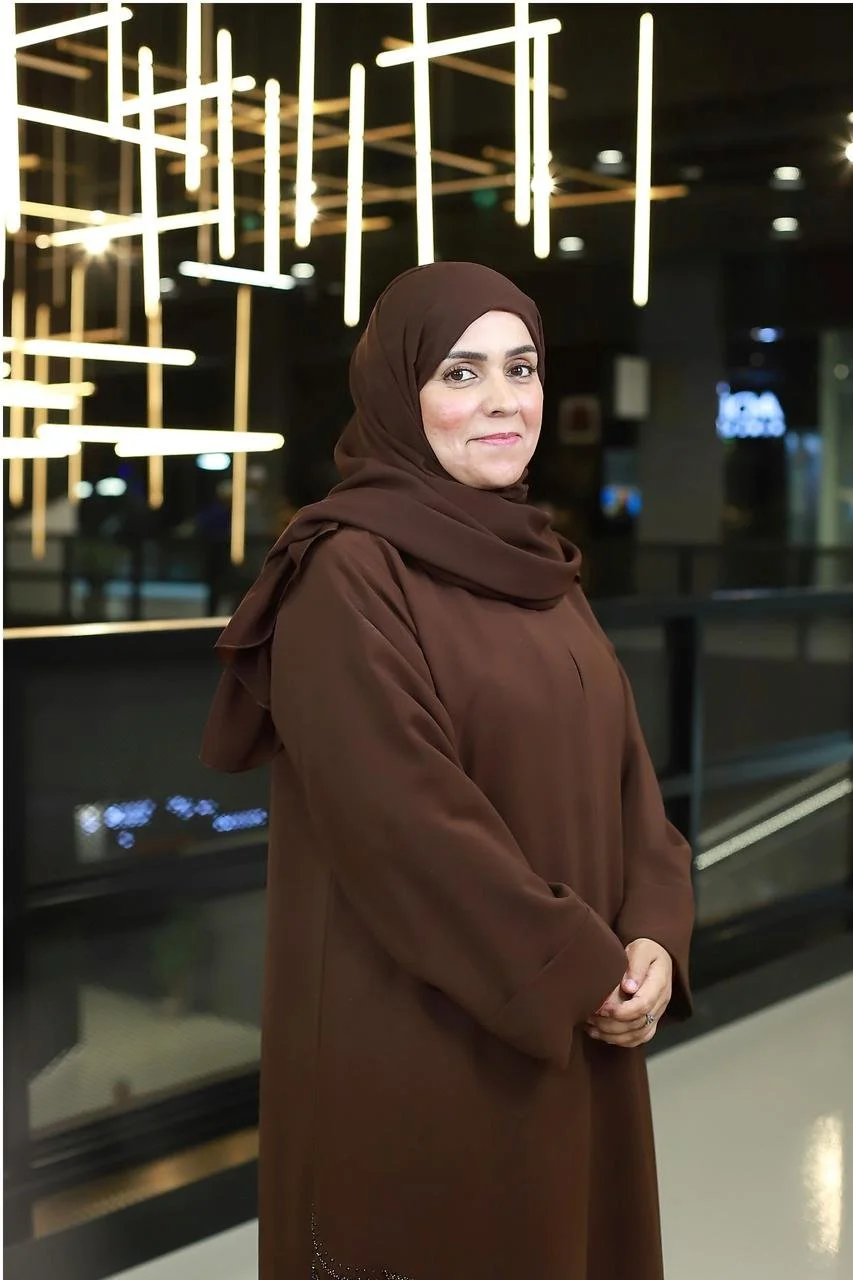
Dr. Fatma Al Balushi, Advisor to the Secretary-General for Museum Affairs
The Al Taykha Breakthrough: Uncovering an Empire of Trade
Oman’s relationship with its earth and oceans is not a modern development, but an ancient legacy etched into its geology. As early as the Bronze and Early Iron Ages, the legendary copper mines of Magan were fueling trade networks across the ancient Near East, proving that mineral extraction has always been woven into the historic fabric of the nation. Today, this heritage of terrestrial fortune continues to shape the Sultanate, drawing a direct line from the ancient copper smelters of the wadis to the sophisticated oil and gas infrastructure of the modern energy landscape. From the deep copper seams of Al Taykha in Al Rustaq to the offshore energy fields of the Arabian Sea, marine and mineral discoveries run through the veins of the Omani people—a timeless bridge between ancestral enterprise and future innovation.
Joint Research with amazing results.
A central highlight of the symposium was a joint working paper presented by Prof. Sara Pizzimenti (Associate Professor of Archaeology at the University of Pisa) and Prof. Khalid Douglas (Professor of Archaeology at Sultan Qaboos University). The researchers unveiled extraordinary 2026 data from the Al Taykha archaeological site located in the Wilayat of Al Rustaq.
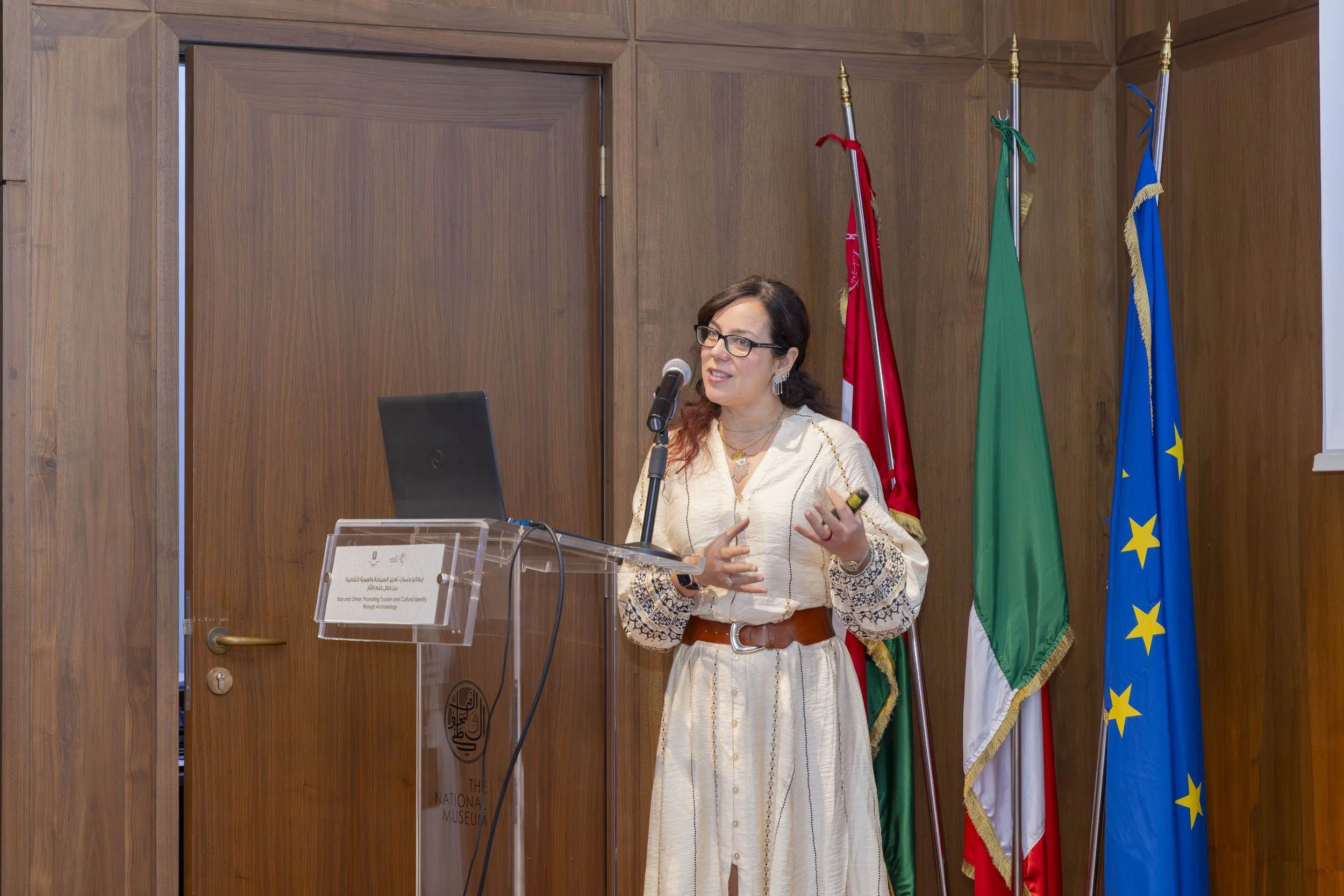
Prof. Sara Pizzimenti (Associate Professor of Archaeology at the University of Pisa)
Prof. Pizzimenti revealed that the true historical climax came with the discovery of three distinct administrative stamp seals within a principal structure. These seals, coupled with ancient smelting furnaces and copper slag, confirm that ancient Oman was not an isolated desert territory, but a highly organized, vital economic powerhouse managing global trade networks that linked the Mediterranean and Mesopotamia directly to the Indus Valley civilization (Harappa).
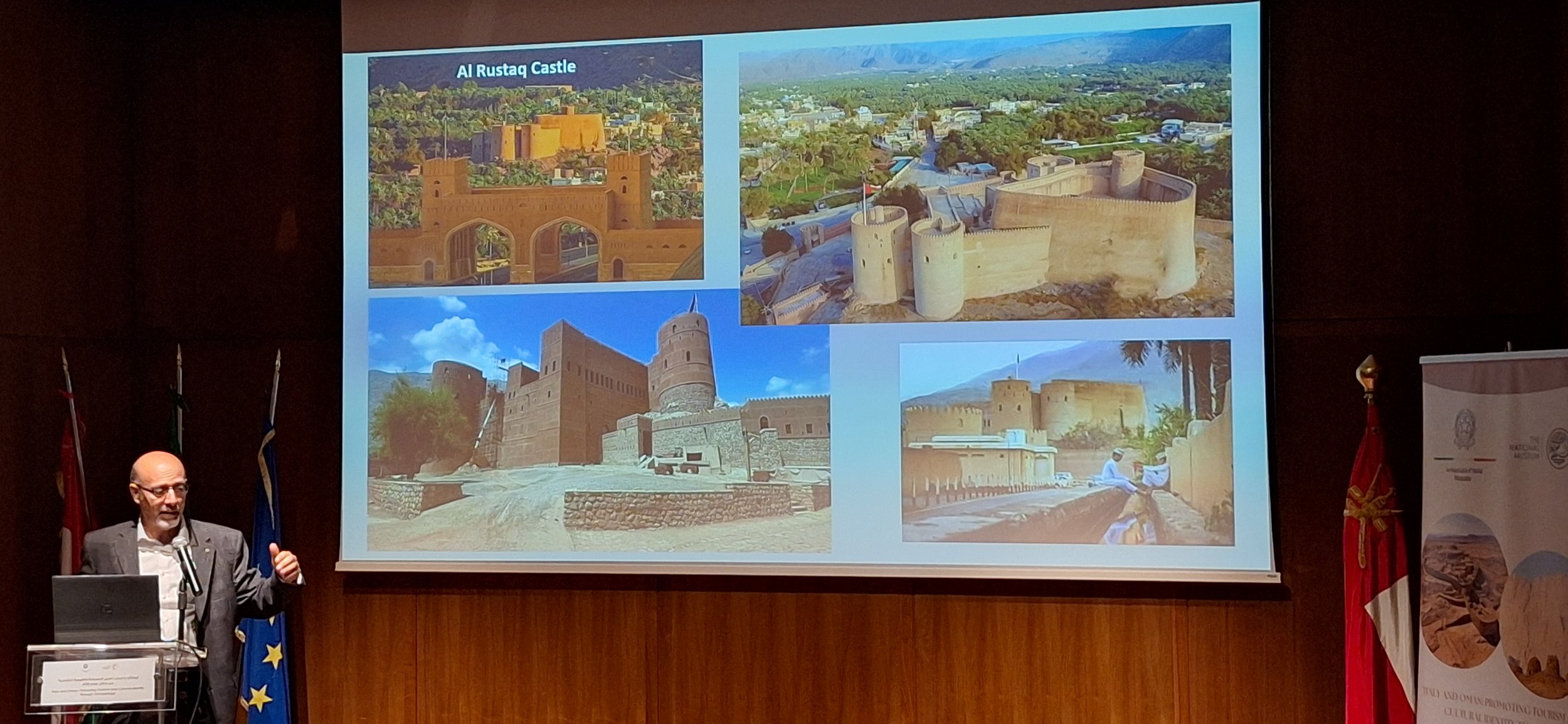
Prof. Khalid Douglas (Professor of Archaeology at Sultan Qaboos University)
Spanning over 70 hectares, Al Taykha is recognized as one of the largest settlements of the ancient Umm an-Nar culture, dating back to the third millennium BCE. The fieldwork exposed a highly sophisticated urban framework consisting of multi-room residential complexes, elaborate circular tombs built from finely cut white stone, and massive circular defensive towers measuring 20 meters in diameter.
The Architectural Legacy: Tommaso d'Errico
The symposium elegantly connected ancient archaeology with modern structural preservation through a paper presented by Tommaso d'Errico, the Honorary Consul of the Sultanate of Oman in Florence. Entitled "Omani Forts and Castles: Their Historical and Architectural Role," d'Errico delivered a moving, personal narrative recounting the monumental legacy of his father, the legendary Italian Architect Enrico d'Errico.
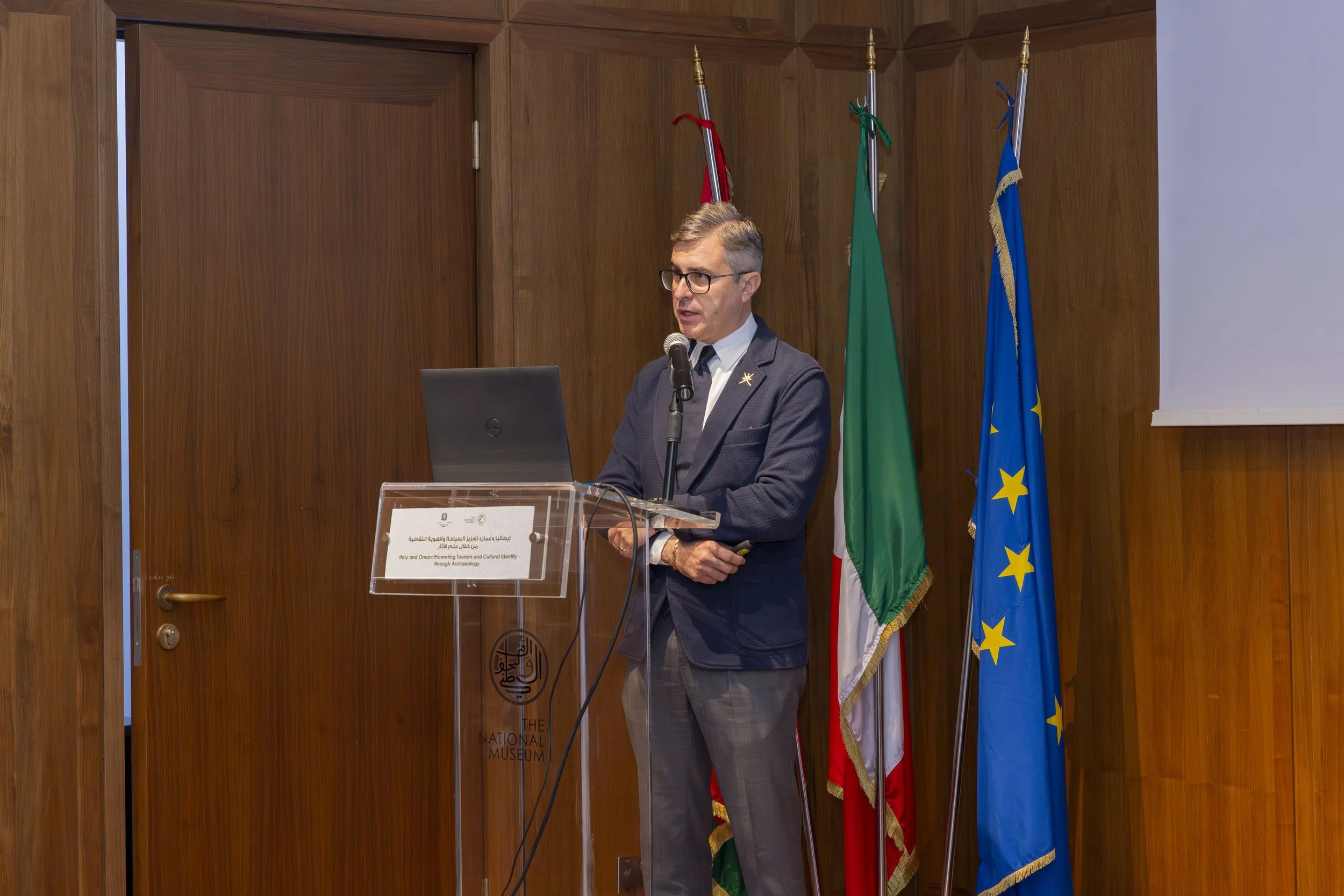
Mr. Tommaso d'Errico, the Honorary Consul of the Sultanate of Oman in Florence.
Having lived in the Sultanate since the age of four while accompanying his father on active assignments, Tommaso detailed how Enrico d'Errico spent decades directly restoring and reinforcing Oman's defensive networks—including the forts of Adam, Jabrin, and Khasab, alongside the castles of Bahla, Al-Mirani, and Muttrah. He noted that these structural monuments served as ancient centers of governance, community life, and education. This historical engineering value acts today as a premium tourism asset, reflecting the deep, natural harmony between Omani architecture and its regional environment.
A unique symposium giving tourism an extra dimension
Ultimately, this profound symposium proved that archaeology is no longer static; it is the foundation for a sustainable, Conscious Tourism model. By uncovering the real human resilience behind the ruins, Italy is helping Oman train its own "National Cadres" in advanced 3D scanning and lab analysis.
The spectacular 2026 season will culminate in an exclusive upcoming exhibition at the National Museum, showcasing the timeless "Merchant Intelligence" that has defined the Sultanate for millennia, ensuring that as Italy unearths Oman's deep roots, a new generation of Omani curators stands fully equipped to protect its future.